
 E-Paper



Delhi schools to reopen in 2 phases from Sept 1
Delhi added 46 fresh Covid-19 cases and no additional deaths on Friday, according to data from the state government’s daily health bulletin, recording a positivity rate of 0.06%. This number has been below 1% for 89 days, and below 5% for 99 days.


Schools, colleges and other educational institutes in the Capital can resume physical classes in a phased manner from September 1, Delhi deputy chief minister Manish Sisodia said on Friday after a decision taken by the Delhi Disaster Management Authority (DDMA) on account of a marked improvement in the Covid-19 situation in the city.
Delhi added 46 fresh Covid-19 cases and no additional deaths on Friday, according to data from the state government’s daily health bulletin, recording a positivity rate of 0.06%. This number has been below 1% for 89 days, and below 5% for 99 days. The city has added a daily average of 32 cases over the past seven days, and has only 412active cases as of Friday.
“The kind of education that can be imparted through physical classes can never be substituted by online classes. So we have decided to allow schools to open,” Sisodia, also the state education minister, said at a news briefing at the Delhi secretariat.
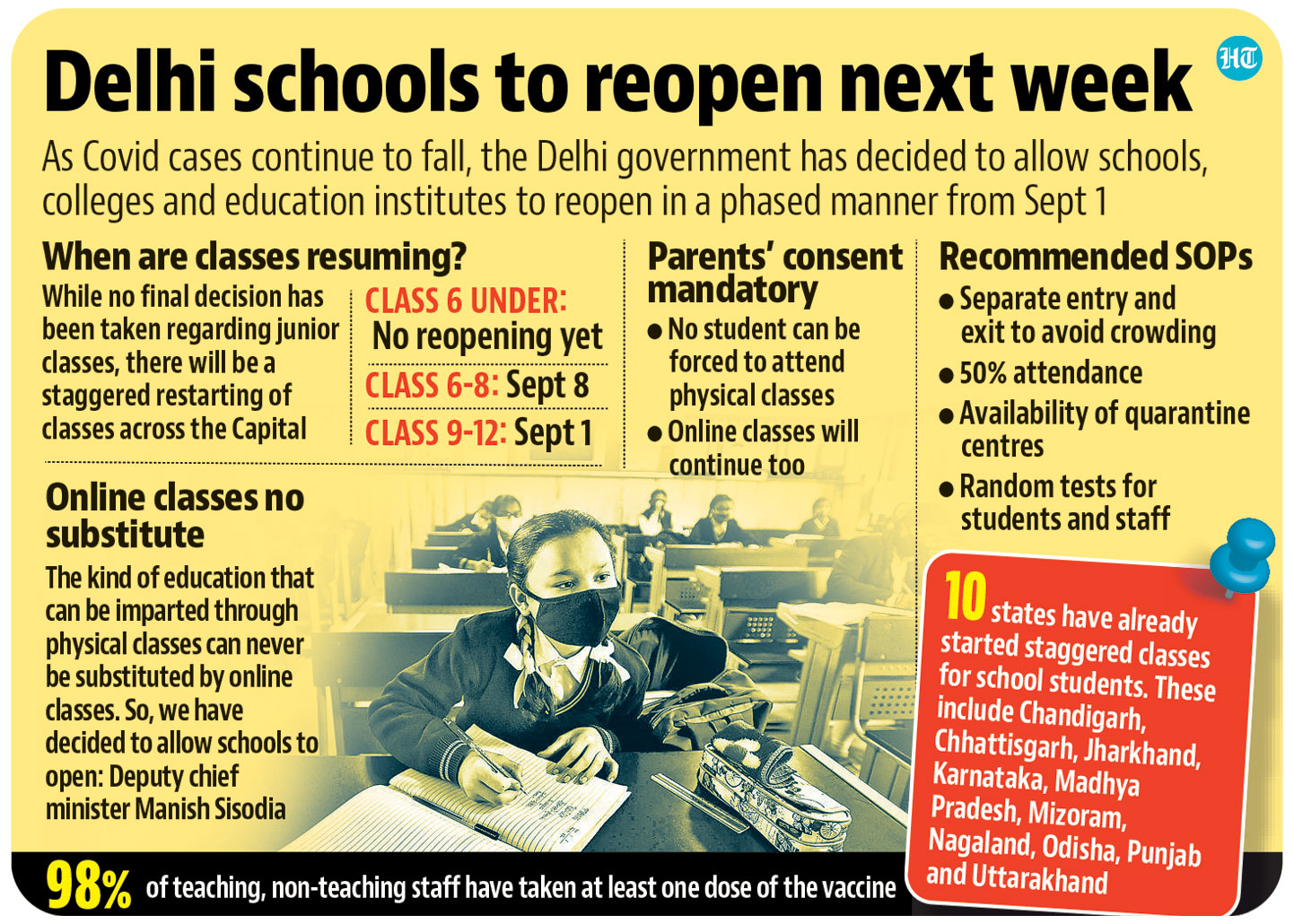
“From September 1, all government schools will open for classes 9 to 12, all private schools can also resume classes for 9 to 12 standards. Coaching centres can also start classes for students of 9 to 12 standards,” he said, adding that colleges can also resume physical classes from September 1.
While Sisodia said the government will observe the situation for a week before resuming junior classes, a senior DDMA official, speaking on condition of anonymity, said the authority has approved classes 6 to 8 to restart from September 8. No decision has been taken on reopening junior classes yet, he added.
Soon after the announcement, chief minister Arvind Kejriwal tweeted, “In view of decreasing Covid cases, schools are being slowly reopened in Delhi with complete precautions, so that the learning loss for students can be reduced. We have to bring back life on track and take care of studies as well as health of students.”
The government, however, stressed that parents will be forced to send children to school, and online classes will continue for those who opt for them. “No child will be forced to attend physical classes and there will be no compulsory attendance. Consent of the parents will be must for students to attend physical classes,” Sisodia said.
Standard Operating Procedures (SOP) for schools will be issued in the next few days, he said.
Schools in Delhi have been shut since March last year when Covid-19 cases first started rising in the country. Classes resumed for a brief period in January and February this year, but were suspended in April as a brutal second wave (fourth for Capital) of Covid-19 stretched the health care infrastructure to its limits.
A statement from the LG office said, “After detailed discussions with experts the need to maintain continued vigil , strict enforcement of COVID appropriate behaviour along with adherence to the strategy of Test, Track & Treat was emphasized... As regards opening of schools it was agreed to by all the members that in the first instance classes 9-12 may be opened (from September 1) subject to strict adherence of the SOPs prepared for the schools by the Education Department. It was emphasized that adequate school preparedness, strict enforcement of SOPs and daily monitoring should be undertaken to avoid any instance of spread of infection in schools.”
At present, India’s vaccination drive only covers adults, with just one vaccine – Zydus Cadila’s ZyCoV-D -- getting an approval for administration in children above 12 years of age. Once the vaccination drive opens for children, likely in October, those with comorbidities will be given priority, the National Technical Advisory Group on Immunization (NTAGI) said earlier this week.
“We need to ensure that the teachers and the staff are vaccinated. Among children, only the co-morbid and the obese will need vaccination. The infection is airborne, so masking is important. The precautions can include reducing the number of hours, calling students in at staggered timings, and having two shifts of teachers,” said Dr Suneela Garg, professor in the department of community medicine at Maulana Azad Medical College.
Dr Anupam Sibal, group medical director at Apollo hospitals, said, “Children have already missed out on 18 months of schooling, how long can it continue? The situation has to be dynamic, if cases start going up it has to be switched back to online classes. Schools have to enforce social distancing, masking, and hand washing.”
In Delhi, 98% of school staff – both teaching and non-teaching – have received at least one dose of the vaccine. “In the last month, we organised special drives to vaccinate teachers and school staff. Around 98% teacher and other staff in government schools have taken at least one dose of vaccine. Private schools also told the government that the majority of staff is vaccinated,” Sisodia said.
There is no official data on the number of teachers who have been fully vaccinated.
The decision to reopen schools drew mixed reactions from parents and teachers.
The Delhi Parent Association criticised the government’s decision. “We feel that the government is taking the decision to open schools under the pressure of private schools, so that they can collect fees for all items from the parents. The government and schools should take full responsibility for the safety of the children by giving an affidavit in the court. A Covid safety committee should be constituted in schools with parents, who can inspect the school regularly to ensure Covid appropriate behaviour and protocols,” the association said in a statement.
Welcoming the decision, Gargi Vidyarthi, whose daughter is a Class 12 student, said, “I am happy that the Delhi government has issued this order. When children are going for holidays and outing, schools are at least safer because they follow Covid-19 safety protocols.”
The National Progressive Schools Conference, which has over 120 Delhi schools at its members, said that the staggered classes and smaller groups of students will allow teachers to give more attention to children.
“We had only been focusing on practicals till now as per government orders and will now focus on theory classes. Once classes begin, we will conduct tests to assess learning levels of students who will be returning to schools after a long gap. Teaching plans will be developed accordingly,” the organisation’s chairperson Malini Narayanan said.


